
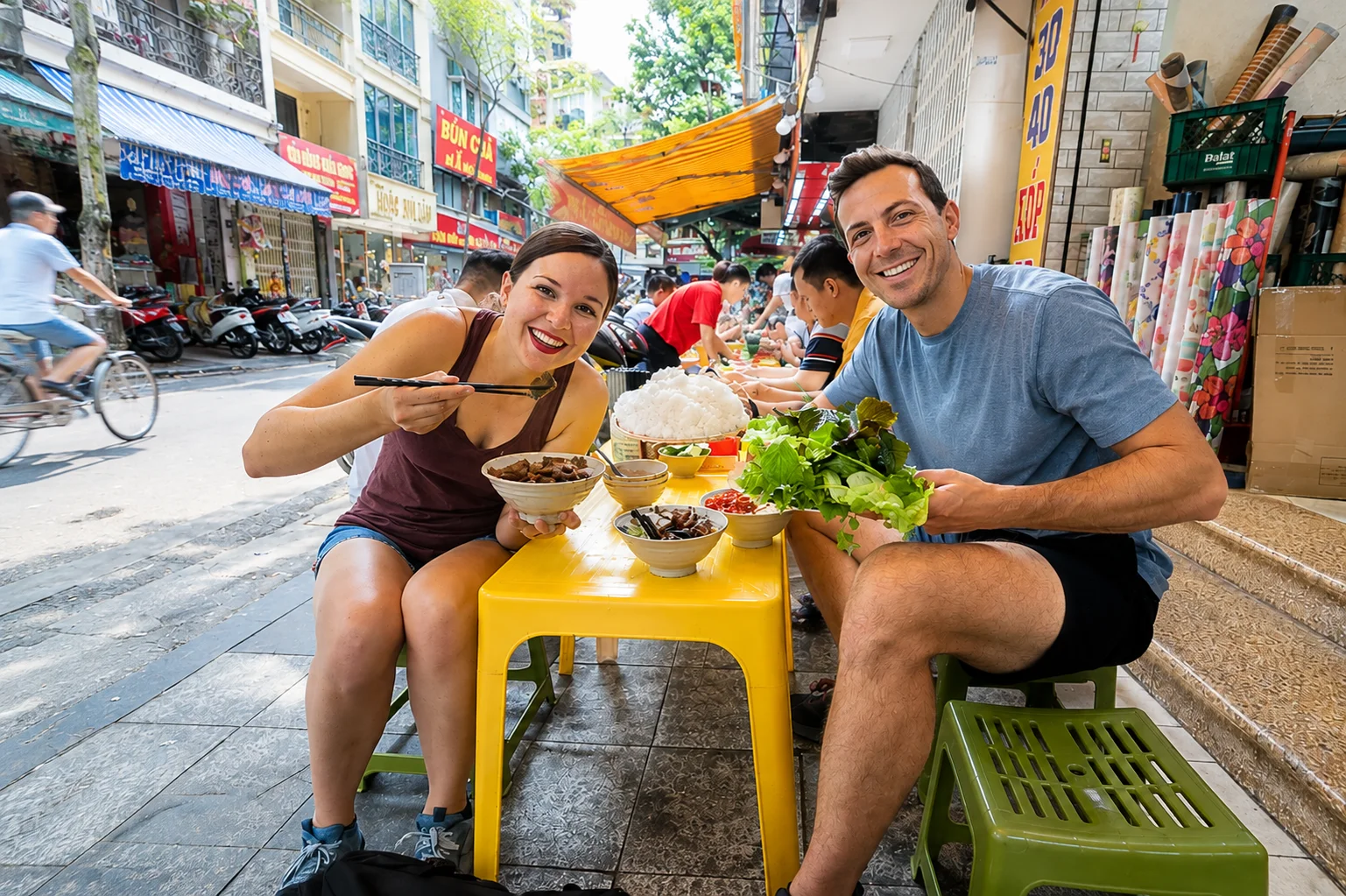
Top 10 Hanoi street foods every traveler should try
Content []
1. Pho
No first trip to Hanoi is complete without trying pho, but the Hanoi version is worth paying attention to. Northern pho is generally more restrained than many southern versions, with a clear broth, flat rice noodles, sliced beef or chicken, and herbs served separately. For a first bowl, pho bo is the obvious choice; pho ga is lighter and equally representative of the city's breakfast culture.
A useful place to start is P. Bát Đàn in the Old Quarter, associated with the long-running Pho Gia Truyen tradition on Bat Dan Street. The area is particularly suited to an early breakfast, when many pho specialists are at their busiest.
|| Good to know: Pho is traditionally a breakfast food, so don't be surprised if some popular shops have limited hours or sell out earlier than expected. If you are new to Vietnamese food, ask for the basic version first rather than adding lots of condiments immediately.
2. Bun Cha
If pho represents Hanoi's breakfast culture, bun cha may be the dish that best captures its lunchtime street-food identity. The meal combines grilled pork patties and slices of pork belly with rice vermicelli, fresh herbs, pickles and a warm, sweet-savoury dipping sauce. Rather than mixing everything into one bowl, you pick up noodles, herbs and meat and dip them into the sauce as you eat.
One of Hanoi's most internationally recognised places is Bún chả Hương Liên at 24 Le Van Huu. It became particularly well known after Anthony Bourdain and Barack Obama ate there, but the dish itself is far more important than the celebrity connection.
For a more Old Quarter-oriented food crawl, Hang Manh and Hang Quat are useful streets to explore, with several bun cha specialists concentrated in the area.
|| Good to know: Bun cha is usually a substantial meal. Order one serving rather than several dishes at once if you are planning to continue a street-food crawl afterwards.
3. Banh Cuon
Banh cuon consists of very thin steamed rice sheets rolled around a filling of minced pork and wood-ear mushroom, then topped with fried shallots and served with a light fish-sauce-based dipping sauce. It is softer and more delicate than many of Hanoi's grilled or fried street foods, making it a good breakfast or light meal.
The most useful thing to know is that banh cuon is best eaten fresh from the steamer. Watch the cook spread the rice batter across the cloth steamer, steam it briefly, then lift and roll the sheet. That preparation is part of the experience.
Bánh Cuốn Bà Hoành is a well-known option at 66 To Hien Thanh. If you are staying around the Old Quarter, you can also look for traditional banh cuon specialists around Hang Ga and the surrounding streets.
|| Good to know: If you are sensitive to strong flavours, banh cuon is one of the easier Hanoi dishes to start with. The dipping sauce can be adjusted with chilli and garlic according to taste.
4. Cha Ca
Cha ca is one of Hanoi's signature dishes and one of the few foods with an entire street named after it. Traditionally, chunks of fish are marinated with turmeric and cooked with dill and spring onions directly at the table. Diners combine the fish with rice noodles, herbs, peanuts and a fermented shrimp sauce or other accompanying condiments.
The experience is as much about the cooking as the finished dish. The fish arrives at the table and continues sizzling while you eat, so this is better suited to a proper lunch or dinner than a quick snack.Chả Cá Thăng Long on 17A Cha Ca Street is a convenient option in the Old Quarter. The historic Cha Ca Street itself is also worth exploring if you want to compare different restaurants.
|| Good to know: Cha ca is generally more expensive than a bowl of pho or bun cha, and a portion is designed as a full meal rather than a small tasting dish.
5. Xoi
Xoi is sticky rice prepared with a wide variety of savoury or sweet toppings. In Hanoi, it can be eaten as a quick breakfast, snack or filling meal, making it particularly useful when you want something inexpensive and substantial.Look for versions topped with mung bean, fried shallots, shredded chicken, pork, Vietnamese sausage or other savoury ingredients. The combination of sticky rice and toppings makes it considerably more filling than its modest appearance suggests.
Xôi Yến on Nguyen Huu Huan is one of the better-known names for visitors exploring the Old Quarter.
|| Good to know: Xoi is an easy dish to share, but portions can be quite filling. If you are planning to eat several dishes during a food tour, consider ordering a smaller portion if available.
6. Bun Thang
Bun thang is one of Hanoi's more refined noodle dishes and a good choice for travelers who want to move beyond the city's better-known pho and bun cha.
The broth is light and carefully prepared, while the bowl typically contains rice vermicelli, shredded chicken, thin strips of omelette, Vietnamese pork sausage and herbs. The ingredients are arranged separately rather than piled together, giving the dish a distinctive appearance.
Bun thang is traditionally associated with Hanoi home cooking and is less immediately recognisable to international visitors than pho or bun cha. That makes it particularly interesting for travelers who have already tried the city's most famous dishes and want something more local.
For a practical Old Quarter option, Bún thang Bà Ẩm on Cua Nam Street is currently listed as serving the dish.
|| Good to know: Bun thang is relatively delicate in flavour. It is worth trying before adding chilli or other strong condiments so you can appreciate the broth.
7. Banh Mi
Vietnamese banh mi is a product of French influence adapted to local ingredients, but Hanoi has its own preferences and styles. A typical sandwich combines a crisp baguette with pâté, Vietnamese cold cuts or grilled meat, pickled vegetables, herbs and chilli.
For visitors staying in the Old Quarter, Banh Mi 25 on Hang Ca is an easy and accessible option, with several fillings and a location convenient for a walking food tour. Other well-known banh mi spots can be found around Au Trieu and Hang Bong.
|| Good to know: Banh mi is ideal when you want something quick between sightseeing stops. If you want a more traditional experience, try a simple filling rather than automatically choosing the most loaded combination.
8. Banh Tom
Banh tom is closely associated with West Lake, or Ho Tay. Small freshwater shrimp are coated in a light batter and fried until crisp, producing a snack with a crunchy exterior and a softer centre. It is usually served with herbs, lettuce and dipping sauce.
This is one of the dishes that gives you a reason to explore beyond the Old Quarter. The traditional association with West Lake makes it particularly suitable for combining with an afternoon around the lake and nearby Tran Quoc Pagoda. Nhà Hàng Bánh Tôm Hồ Tây on Thanh Nien Street is one of the established names associated with the dish.
|| Good to know: Banh tom is best eaten hot. The texture changes quickly after frying, so it is worth eating shortly after it arrives rather than ordering it to take away.
9. Nem chua ran
For something completely different, try nem chua ran. These small fermented pork rolls are coated and fried, producing a crisp outside and a chewy, savoury centre. They are usually eaten as a casual snack with cucumber, herbs and dipping sauce.
The best place to look for them is Tam Thuong Alley, a small lane off Hang Bong that has long been associated with fried fermented pork and other inexpensive snacks.
A convenient option is Cửa Hàng Nem Chua Rán - 36 Tạm Thương. Another nearby option is Nem Chua Rán Thành Xăm on Hang Bong.
|| Good to know: Nem chua ran is more of a snack than a complete meal, so it works particularly well as part of an evening food crawl. If you are unfamiliar with fermented foods, ask what you are ordering before choosing a large portion.
10. Che
Save room for che, a broad family of Vietnamese sweet soups and desserts. Depending on the recipe, a bowl may contain beans, lotus seeds, jelly, coconut milk, sticky rice, fruit or other sweet ingredients. Some versions are served warm, while others are chilled with ice.
Unlike pho or bun cha, there is no single "correct" bowl of che to order. Ask the vendor what is popular that day or choose a combination that includes ingredients you already recognise.Xôi chè bà Thìn near Bat Dan is one established option in the Old Quarter. It is particularly convenient if you are already exploring the area around the traditional food streets.
|| Good to know: Che can be surprisingly filling after a full day of eating. A small serving is often enough, especially if you are using it as the final stop of a street-food crawl.
11. How to explore Hanoi's street food like a local
Hanoi street food works differently from a conventional restaurant scene. Many vendors specialise in one dish and may operate only during a particular part of the day. A busy breakfast shop may close before lunch, while a snack stall may only become active in the afternoon or evening.A simple way to plan your food exploration is to follow the city's daily rhythm:
Breakfast: pho, banh cuon or xoi
Lunch: bun cha or cha ca
Afternoon: coffee, banh mi or che
Evening: nem chua ran and other street snacks
The Old Quarter is the easiest area for first-time visitors because many food streets are within walking distance of one another. Bat Dan is associated with pho, Hang Manh with bun cha, Cha Ca Street with turmeric fish, and Tam Thuong Alley with fried snacks.
Don't assume that the most famous place is automatically the best choice. Look for busy shops with a clear speciality and a steady flow of customers. For small street stalls, it is also sensible to choose food that is cooked fresh and served hot.
Most importantly, don't try to eat all ten dishes in one day. Two or three proper meals plus a couple of small snacks will give you a much better experience than turning Hanoi into a food checklist.
Restaurant names, locations and operating hours can change, particularly for small family-run businesses. Check the latest opening information before making a special trip.